ISO 9001-2008, ISO 17100:2015 & ISO 27001 CERTIFIED
Having content on your website translated into multiple languages is key to expanding globally, gaining customer trust and improving user experience.
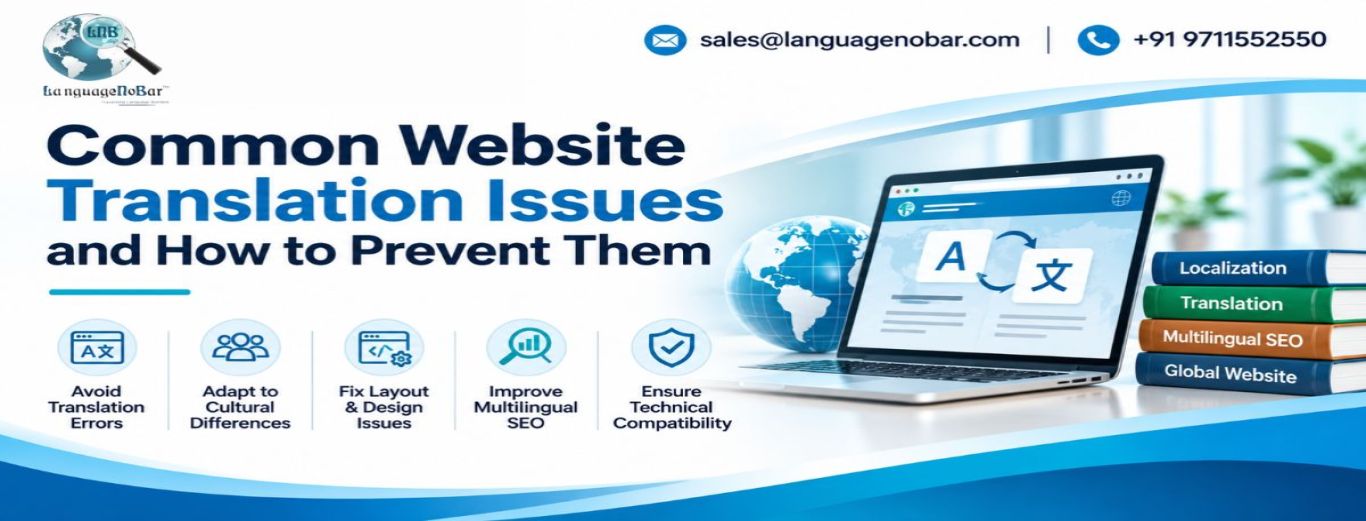
When translating website content, there are several considerations to make. These include cultural adaptations, SEO design, technical compatibility, and accuracy.
If translations are done incorrectly, it can cause confusion for users and affect brand credibility. Considering common issues faced when translating website content and knowing how to avoid them can create a successful multilingual website.
A common issue with translating website content occurs when content is inaccurately translated. This can occur due to jargon/industry specific terms, marketing phrases, or technical information.
Some phrases that sound very professional in English can appear awkward or confusing in translation.
How to fix this:
Have professional translators
Use industry specific translators for technical, legal and medical translations
Ensure consistent terminology throughout your site
Proofread content
By using professional translation services, businesses can ensure that the meaning is preserved, whilst making the content suitable for your target audience.
Words, images, colours and phrases can be culturally specific. Therefore, content which works well in one country may not be appropriate in another
Cultural differences can have an impact on how your website's content is perceived. This could include jokes, idioms, product descriptions, and marketing.
How to fix this:
Research what cultural preferences your target audience has
Adapt examples, phrases and marketing to suit local expectations
Consider using dates, currencies, units of measure and preferences relevant to each region
Get native speakers with knowledge of the target market to review content.
By localizing your content, you can create a more natural experience for global users.
Depending on the language, the translated content may take up different amounts of space. Some languages may require more characters or use different sentence structures and orientations.
German may mean that more space is taken up by the content in comparison to English. Arabic and Hebrew content will be displayed in a right to left format.
This can create issues including overlapping text, broken buttons, misalignment within menus, and uneven layout.
How to fix this:
Ensure that your website is responsive to multiple languages.
Create adaptable text boxes and buttons.
Check out the layout of your website post-translation.
Ensure that fonts, spacing, menu design, and mobile versions are correct.
Before making your multilingual site live, test the design of your web page in all target languages.
Failure to consider SEO during translation can mean that you struggle to gain visibility in search engines for international users.
Sometimes businesses will simply translate keywords from English without researching how people in different countries search for products/services in their language.
As a result, you may struggle to gain visibility in search engines, get irrelevant traffic, and perform poorly organically.
How to fix this:
Research keywords in each target language
Translate and optimize title tags and meta descriptions in each language
Use specific URLs for each language
Add appropriate hreflang tags
Translate alt text, headers and internal links
Submit multilingual sitemaps to search engines
To allow search engines to identify the correct language and locations for each page of your website, set up a comprehensive multilingual SEO strategy.
Technical errors can mean that users and search engines aren’t able to view the correct language version of your website.
Common technical errors include language switchers not working correctly, incorrect redirects, duplicate content, missing hreflang tags and incompatible plug-ins.
This can lead to poor performance on your website.
How to fix this:
Choose a multilingual platform/plugin that suits your needs.
Ensure the URL structure is correct for each language.
Test language switchers and links.
Check redirects and canonical tags.
Monitor performance and indexing regularly.
It is very important to test the technical aspects of your multilingual website.
To create a consistent experience across all of your web content, it is important that terminology is consistent.
If medical terminology is inconsistently translated in product pages, blogs and services on a pharmaceutical website, for example, it can confuse users and damage credibility.
How to fix this:
Create a multilingual glossary
Use memory translation tools
Set clear terminology guidelines
Assign competent people to review key content
Update translated content if the original content is changed.
Using consistent terminology across languages will create a professional and credible brand.
Another common error is not testing translated content.
Even if the content has been accurately translated, there may be issues with formatting, broken links, missing images and navigation issues. This can cause issues for users exploring your website.
How to fix this:
Conduct quality checks on the language.
Test all languages on desktop, tablet and mobile.
Ensure buttons, forms, menus and internal links are working.
Ensure images and downloadable documents are correct in translation.
Ask for feedback from native speakers.
By regularly carrying out quality checks, you can ensure that all language versions of your website function correctly and provide a consistent user experience.
Translation of content on your website is a great way to grow internationally. However, to get the best results, you must consider accurate translation, cultural adaptation, multilingual SEO, technical compatibility, and user experience.
Understanding these common errors and how to avoid them means that you can create a multilingual website that effectively engages with international audiences.
Working with professional translators can help to ensure that translations are high quality, consistent, and culturally appropriate.
Language Obar offers professional website translation services, and multilingual language solutions to help businesses engage with people around the world. By choosing the right translation strategy, you can create a powerful communication platform to grow your business globally.