ISO 9001-2008, ISO 17100:2015 & ISO 27001 CERTIFIED
ISO 9001-2008, ISO 17100:2015 & ISO 27001 CERTIFIED
As businesses continue to grow internationally, the ability to communicate effectively with customers, employees, and partners in multiple languages can be an asset. Whether legal documents, marketing collateral, or websites, professional translation services play an important role in facilitating global business relationships. India is home to a wide range of languages, cultures, and expert organizations. As such, businesses should consider various key factors prior to hiring any translation agency in India.
Prior to establishing a partnership with any translation company India , businesses should consider several key factors to ensure effective communication across borders.
The first factor to consider is the translation company’s experience and expertise. A reputable and competent translation agency should have a strong command of the language's peculiarities, nuances, dialects, and other elements of the languages they use. For example, a firm translating marketing materials into Hindi will have a different skill set than a company engaged to render legal contracts from German into English.
Equally importantly, businesses must ensure that the targeted translation company has the appropriate industry knowledge. The healthcare, banking, legal, manufacturing, information technology, and eCommerce industries have substantially different sets of jargon, instructions, and specifications for translation services.
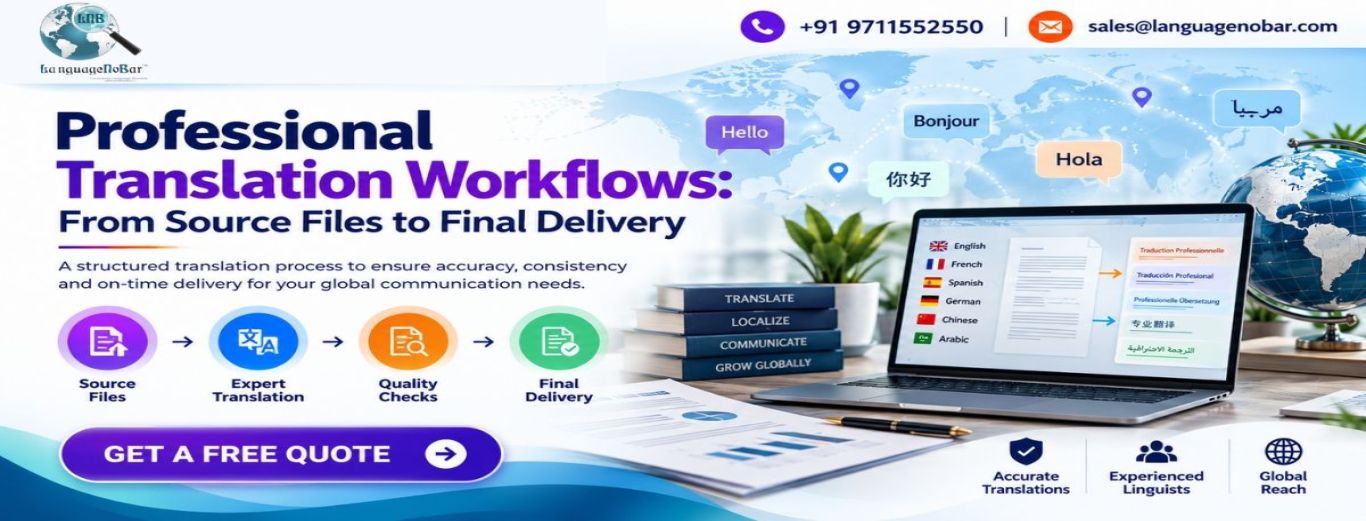
The quality of the translated materials plays an important role in ensuring smooth business operations, as well as maintaining a company’s reputation and market position. Any mistranslation can result in negative and confusing information for clients and partners, which inevitably affects the bottom line. A competent translation company should be able to demonstrate a clearly defined quality assurance process. For example, an assignment may involve translation, editing and proofreading, copy checker review, and final quality check stages.
Businesses should also ask about the company’s response to their comments and concerns, as well as how the firm manages terminology throughout the entire project. Large-scale assignments or regular translations may require companies to submit a sample document to ensure a uniform quality standard. It may also be possible for businesses to request a paid pilot project to ensure full client satisfaction.
It is a common misconception that translation only involves substituting words in one language with their meaning in another. In fact, translation often requires localization – a process involving adjusting the source material to fit the target audience and region. For instance, advertising campaigns require substantially different approaches and language to resonate with Indian and European customers. In addition, dates, numbers, measures, image captions, and other elements may need to be adapted for foreign audiences.
When considering a professional translation company India, businesses should specifically request information regarding both translation and localization options to meet their specific business needs.
Modern translation companies employ cutting-edge technologies to manage increasingly complex translation projects. Businesses may want to ask the potential translation company about the technologies they use to ensure consistency and quality across their documents. Computer-assisted translation tools help to manage the translation process and store commonly used words and phrases in databases for future use. This helps to reduce costs, especially for companies with regular and recurrent project needs.
Some translation agencies offer to use automated tools, such as artificial intelligence, to translate documents. Businesses should carefully consider whether this approach is suitable for their intended use and level of confidentiality. In addition, linguists may need to edit and review automated translations.

For many businesses, confidentiality and security are of paramount importance, as they deal with sensitive information, including employee data, pricing, contracts, and financial statements. Prior to hiring a translation agency, businesses should ask the potential company to share their information security policy and related procedures.
Companies should be aware of what information may be shared or stored within the translation company, as some agencies may use third-party tools to help with the translation process. Businesses dealing with sensitive information may want to specifically discuss legal and regulatory requirements related to confidentiality, as well as specific protections they can implement, such as non-disclosure agreements.
The cost is always an important factor, although businesses should avoid selecting the cheapest option since it may not provide the best value for money. Firms must also consider the timing and flexibility of the translation company, as different assignments may have varied requirements, such as word count, language-specific instructions, formatting, proofreading, project management, and delivery instructions.
Companies must ensure that the cost considerations are realistic and take the complexity and volume of work into account.
It is also helpful to understand if the translation company charges per word or hourly, or if the price is calculated per project. Businesses should also clarify the payment procedures for rush jobs, additional editing work, and other expenses related to the project. The flexibility of the translation company should also be considered to meet the changing demands of a business.
Effective communication is often the difference between a successful and a failed project. Businesses must ensure that the translation company has efficient client support and communication infrastructure, including timeline estimations, dedicated project managers or representatives, transparency, and other crucial processes. Whenever possible, it is advisable to review and analyze references and testimonials to gain an understanding of the company’s strengths and weaknesses, as well as the experiences of other businesses in the past.
Businesses must ensure that the potential translation company fully understands their unique requirements and can handle challenges, such as addressing client feedback, project scope changes, and complex instructions. A competent and reliable translation agency will be able to provide realistic expectations for a given project without overpromising.
Selecting a reliable and competent translation company is vital to ensure effective global business communication. Businesses must ask the right questions and understand their requirements prior to hiring any translation agency.
The companies must understand that a professional translation company India will help to deliver high-quality and consistent content, as well as support effective communication across borders. Businesses can maximize the benefits of hiring translation services by identifying the most suitable partner considering such factors as language expertise, industry knowledge, quality assurance, cultural considerations, technology, confidentiality and security, cost, flexibility, and client communication. Companies should always start with a small project or a pilot assignment to test a company’s performance and ensure there are no issues prior to submitting larger assignments.