ISO 9001-2008, ISO 17100:2015 & ISO 27001 CERTIFIED
ISO 9001-2008, ISO 17100:2015 & ISO 27001 CERTIFIED
Today’s global marketplace means that businesses are always communicating with customers, partners, employes and stakeholders in different languages and cultures. Accuracy is vital to protect a company’s reputation and ensure straightforward communication, whether it’s a website, legal document, marketing campaign, product manual, or business proposal.
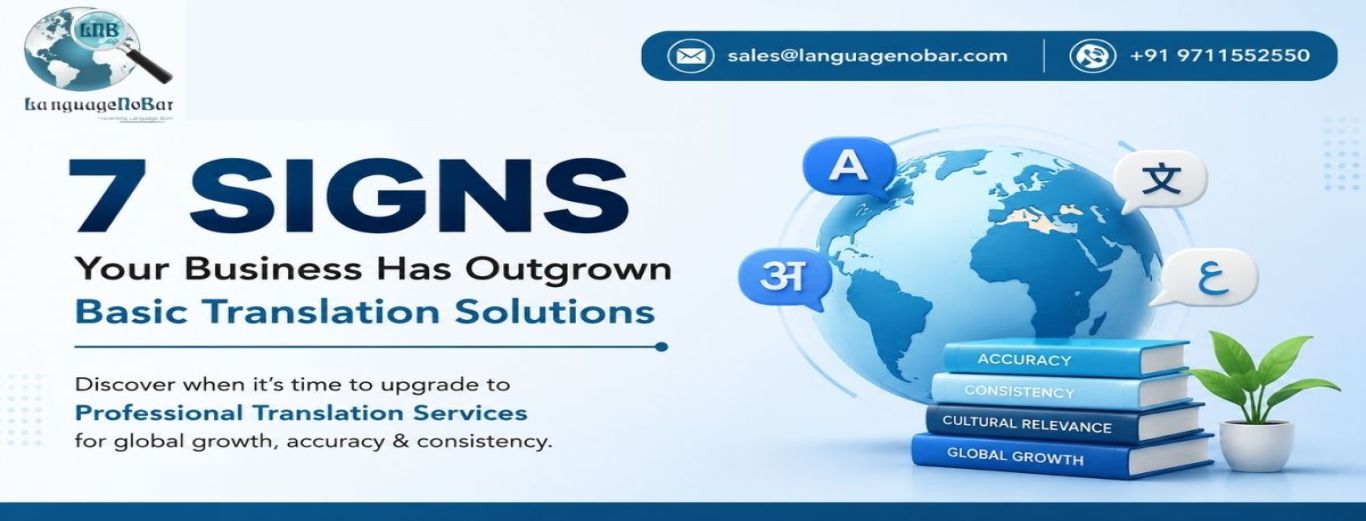
Translation is not simply the substitution of words of one language by words of another. Language differences, cultural backgrounds, industry terms, and local expectations are just a few of the factors that can affect the meaning of translated content. That’s why many organizations choose Professional Translation Services – for accuracy, consistency, and cultural relevance.
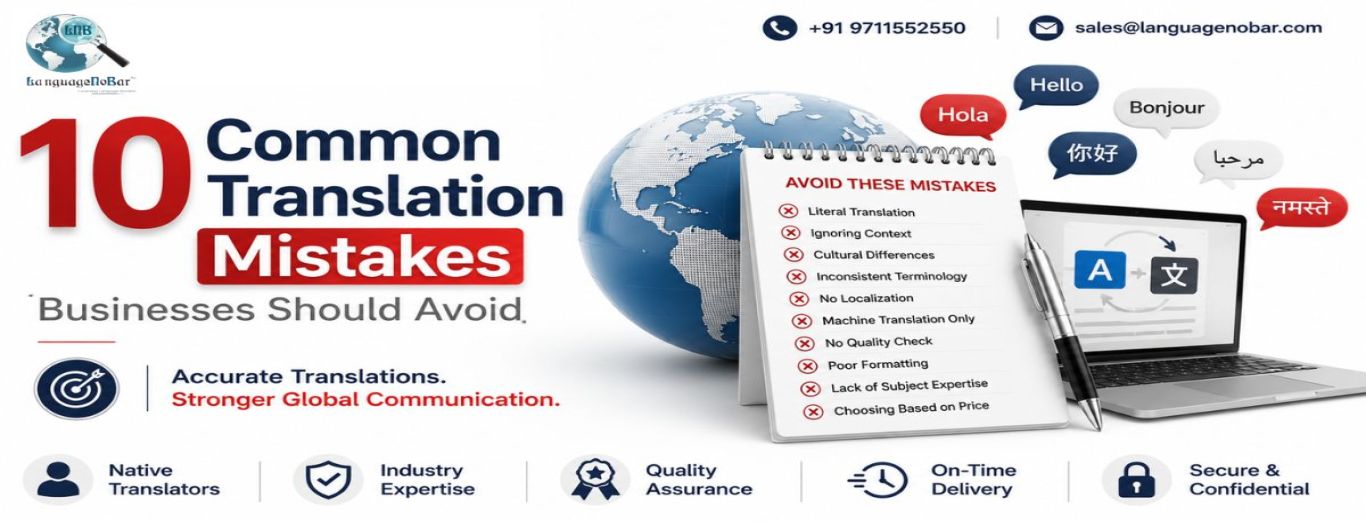
Here are ten common translation mistakes to avoid when communicating with international audiences.
1. Simply machine translation
The automated translation tools can be a good help for understanding the gist but depending on automatic translation for important business communications can lead to serious errors.
Sometimes, the context, technical terms, tone or cultural aspects can get lost in AI translation tools. This is particularly dangerous in legal, medical, financial, and technical documents.
Human translators know how to look for context and intent, so the translation reflects the correct meaning.
2. Translating Words Instead of Meaning
One of the most common faults of translation is its being literal. Every language has its own grammar, expressions, and ways of communicating.
What sounds natural in English can sound strange or confusing when translated literally word-for-word into Hindi, Arabic, French, Japanese or some other language.
Professional translators translate with the goal of conveying the intended meaning, not the word-for-word translation.
3. Ignoring Cultural Differences
Translation is not just linguistics, but cultural.
Colours, symbols, jokes, examples, idioms, images and expressions may have a very different meaning in another market. What’s good about marketing content in one country isn’t always good about marketing content in another.
Localization and translation are key to effective communication, and businesses should think about localization when translating their content.
4. Non-Industry Experienced Translators – How to Use Them
Not all bilinguals can translate specialist business material.
Healthcare, pharma, manufacturing, finance, technology and law are all very language specific. A single technical term can be misunderstood, and the meaning of a document is altered.
Professional Translation Services / Industry experienced translators can help companies ensure the use of correct terminology and consistency of subject matter.
5. Terms inconsistency
Imagine a company that describes the same feature differently on its website, in its user manual, on its mobile app, and in its marketing materials.
This can confuse your customers and make your brand less consistent.
Professional translation projects often employ terminology databases, glossaries, translation memories, and style guides. This ensures that translators use the same terminology in different documents and communication media.
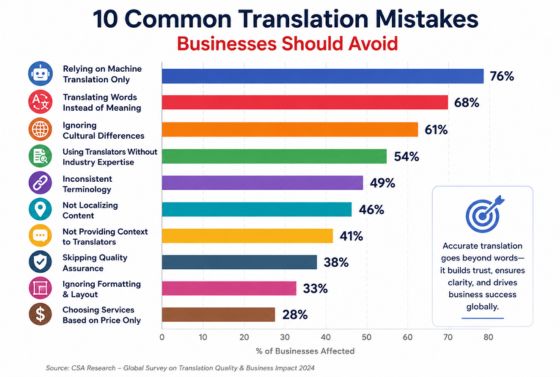
6. Not Localizing
Translation and localization are two sides of the same coin; but they are not the same thing.
To translate is to render something written from one language into another. Localization is the adaptation of content to a target market or region.
For localization you can make the following adjustment:
Currency and units of measure Date/time formatting *Phone number formats Photographs and images References * Cultural Expressions * Language origin
Elements of a Website Interface are:
This is why companies that want to go internationally need to know if they need to translate or fully localize their content.
7. No Context for Translators
“Sometimes even the most experienced translator can’t depend on the context of the content.
For example, a short phrase can have many different meanings. It can be on a button on a website, on a software interface, in an advertisement, in a legal agreement, or in a technical document.
When working with translators, businesses should always try to provide reference documents, screenshots, terminology preferences, brand guidelines, and information on the target audience.
More context usually leads to better translations.
8. Skipping on Quality Assurance
Don’t stop translating after the first draft.
Without good proofreading and quality assurance, spelling mistakes, formatting problems, inconsistencies in terminology, missing sentences, or wrong numbers can be easily missed.
The professional translation process includes delivery, language review, and quality checks. For highly specialist projects, Subject Matter Experts can also be involved in the review process.
9. Neglecting formatting and layout
Some languages take up more room than others.
The translation might be longer or shorter than the original sentence. Arabic is one of these languages. The writing is right to left. This affects the general layout of a document or website.
Therefore, companies need to review the translated content in the final design or interface. This is especially the case for websites, brochures, presentations, software applications, packaging, and user manuals.
10. Cost of translation services
The cheapest translation might save you money in the short term, but a bad translation will cost you a lot more in the long run.
Poor translations might have to be started from scratch. They can confuse your customers, create compliance issues, or damage your reputation.
Price is a consideration, but companies also need to consider factors such as translator expertise, language capabilities, quality processes, industry experience, information security, turnaround time and ability to scale projects from a translation provider.
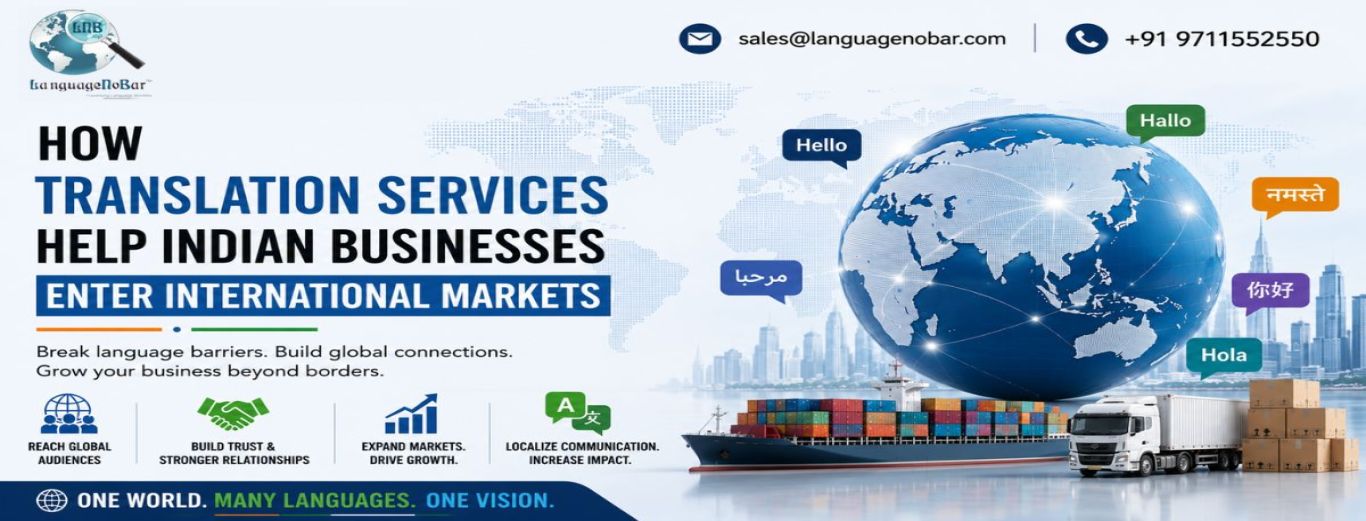
“Having multilingual communication is critical in new markets to build credibility and deliver consistent customer experiences.”
Translation services bring together language skills, cultural knowledge, subject matter expertise, process discipline and quality control. This allows organizations to communicate accurately and to preserve messages and brand recognition in various languages.
We offer professional translation services for legal contracts, technical manuals, websites, marketing campaigns, medical documents, and corporate communications. It facilitates reducing miscommunication and makes information more available to a global audience.
Mistaken translations can be harmful to business. Poor quality control. lack of context lack of localization inconsistent terminology literal translation can result in poor international communication
Translation is not just words translation; it is a big part of the global strategy of a company. You need to work with experienced Professional Translation Services for content that is accurate, culturally relevant, consistent and effective across markets.
For companies looking to expand into global markets, quality translation should be viewed as an investment that will result in more effective communication, better customer relationships, and long-term global growth.