ISO 9001-2008, ISO 17100:2015 & ISO 27001 CERTIFIED
ISO 9001-2008, ISO 17100:2015 & ISO 27001 CERTIFIED
If you’re looking to grow your business in international markets, it’s not just about translating the content on your website. Different countries have different customers, with different languages, cultural expectations, buying habits, currency, and communication preferences. If it looks natural and familiar, native visitors will trust it more.
That’s were website localization services come into play. Website Localization is the process of adapting your website to the language, cultural, and regional requirements of a specific market while still retaining your trademark.
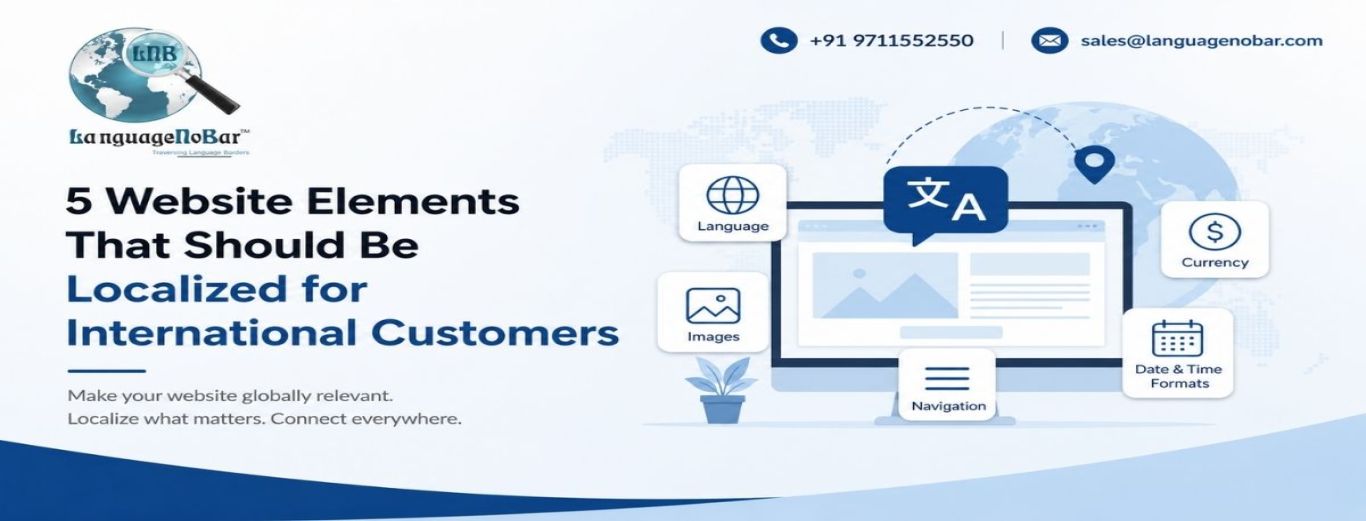
Here are five website elements to localize for international customers
Website content is one of the first things international visitors see. When translating words from one language to another, sometimes the message doesn’t always get translated.”
Localization: Not a word-for-word translation. This means tone, cultural references, terminology and communication style, and local idioms. Target Audience When writing headlines, product descriptions, landing pages, blogs, calls to action and other marketing content you need to consider the target audience.
For example, an English phrase that sounds reasonable may sound strange or confusing when translated literally into another language. Or you can say the same thing in the localized version with words and phrases that will sound natural to the customers.
Professional Translation services assist companies in maintaining content consistency while making it appealing to local audiences.
Visuals are also important for website localization. Images, icons, illustrations, videos, and graphics may have different meanings or cultural associations in different regions.
“Companies need to screen visual content before going live with a localized site. Images must be relevant to the target market and include people, clothing, food, colors, gestures, or social situations.
Text in images should also be translated and localized where necessary. Possibly more adaptation needed: infographics, banners, promo graphics, screenshots, and videos.
Localization allows international companies to adapt visual content so that their website feels more relevant and not like a translated version of a site for another country.
Another important thing that needs to be localized is pricing for international customers. Show prices in the customer’s chosen currency. This allows for the decision to buy to be easier and contributes to a more comfortable experience.
For example, if the company sells to customers in India, then the price can be shown in INR but for customers in USA it can be USD. Companies focused on the European market may need to look at EUR and other regional currencies.
Localization should be complemented by:
Number formats, currency symbols (local)
Thousands and decimal separators
Taxes and Other Costs
Location based pricing
Payment Options & Countries
What information do you need to charge me?
Different countries have different ways to pay. There’s many. Providing payment options that your customers recognize can help reduce friction at checkout and potentially increase conversions.

Small formatting changes can have a big impact on user satisfaction. Date, time, address, and telephone numbers will vary from country to country. Measurement formats will vary from country to country.
For example, 03/08/2026 could be August 3 or March 8 depending on where you are. Some have a 12-hour clock while others have a 24-hour clock to tell time in the markets.
Businesses need to consider localization.
Date/Time Formats.
Time zones & time formats
Telephone number formatting
Addresses for mailing
Measurement Units
Determinations of Mass and Temperature
Decimal separator, numerals
These may seem like small things, but if you get them wrong, it can confuse people and make your website look less trustworthy.
The navigation and interactivity of the website should also be adapted for international visitors. It includes menus, buttons, contact forms, registration pages, checkout processes, error messages, and search functionality.
Some languages are longer than the English one. Some languages are right-to-left. Which means website layouts need to be flexible enough to accommodate different languages without cutting off text or leaving weird gaps.
Forms should be consistent with local expectations. Depending on the target country, this may include modification in address fields, telephone numbers, names, postal codes, and region selection.
The website has a user-friendly and straightforward user interface that enables visitors to easily navigate the website and attain their objectives.
A localized website helps a business to relate better to overseas customers. When language, content, images, prices, and user experience meet local expectations, visitors are more likely to trust a website.
A website localization can help a support company to:
Increase engagement with customers globally
Establish brand credibility in new markets
Make your users feel more personal
Decrease language & culture confusion Increase conversions on your site
International SEO strategy help
Raise brand awareness worldwide
But good localization is far more than just machine translation. Delivering consistent experience across markets relies on human linguistic expertise, cultural knowledge, and technical quality checks.
Professional Website Selection Localization Services
“There are great opportunities for international expansion, but companies must make sure their digital experiences are relevant and accessible to local audiences. Customers’ perception of a brand can be affected by anything from website content and images to currencies, formats, navigation, and forms.
Professional Website Translation Services help businesses localize their website for target markets, while maintaining a consistent brand of voice and messaging. A good localization strategy will not only make your website “speak another language” but also make it feel as if it was built for the customers you want to attract.